
If you head to a Winnipeg emergency department for a bump on the head this week, you might face a wait time of over 11 hours. It’s an overwhelming reality for many local families. We understand the deep anxiety that follows a sudden fall or a sports collision. You’re often stuck wondering if a persistent headache is just a bruise or something more serious, yet the thought of sitting in a crowded hospital lobby for half a day is daunting. Finding a professional assessment for minor head injury in Winnipeg shouldn’t be a source of extra stress when you’re already worried about your health.
Our goal is to provide the clarity you need to make the best decision for your recovery. We’ll show you how to identify specific concussion symptoms, explain when to choose a neighborhood walk-in clinic over the hospital, and walk you through what to expect during a clinical evaluation. We’ll also explain how Manitoba Health billing works for your visit. By the end of this guide, you’ll have a clear path toward peace of mind and a structured recovery plan that helps you get back to your daily routine safely.
Key Takeaways
- Learn how to distinguish between life-threatening emergencies and non-critical head bumps to help you avoid unnecessary eleven-hour ER wait times.
- Understand the specific neurological and cognitive tests our physicians use to provide a thorough assessment for minor head injury in Winnipeg.
- Discover the importance of the “Cognitive Rest” phase and how to safely navigate a contemporary step-wise return to your daily work or school routine.
- Find out how professional assessments for minor injuries are typically covered through Manitoba Health, ensuring your visit is straightforward and clear.
- Identify the specific red flags that require immediate emergency intervention versus symptoms that our local walk-in clinic can safely manage.
Understanding Minor Head Injuries and Concussions in 2026
A minor head injury (MHI) is often categorized by medical professionals based on the Glasgow Coma Scale, where a patient remains conscious or only loses consciousness briefly. However, we’ve learned that “minor” is a bit of a misnomer. Even if an injury doesn’t require surgery, it can still disrupt your life. In a city like Winnipeg, these injuries stem from several common sources:
- Slips on black ice during the long winter months.
- Sports collisions in local hockey or soccer leagues.
- Accidental falls at home or in the workplace.
By 2026, clinical standards have shifted toward much higher levels of caution because we now understand the long-term risks of untreated brain trauma. Getting a professional assessment for minor head injury in Winnipeg is now the standard recommendation for any significant impact. Whether you slipped at The Forks or took a hit during a hockey game, waiting to see if you feel better is no longer the best advice. Modern protocols focus on early detection to ensure the brain has the resources it needs to heal.
What is a Concussion?
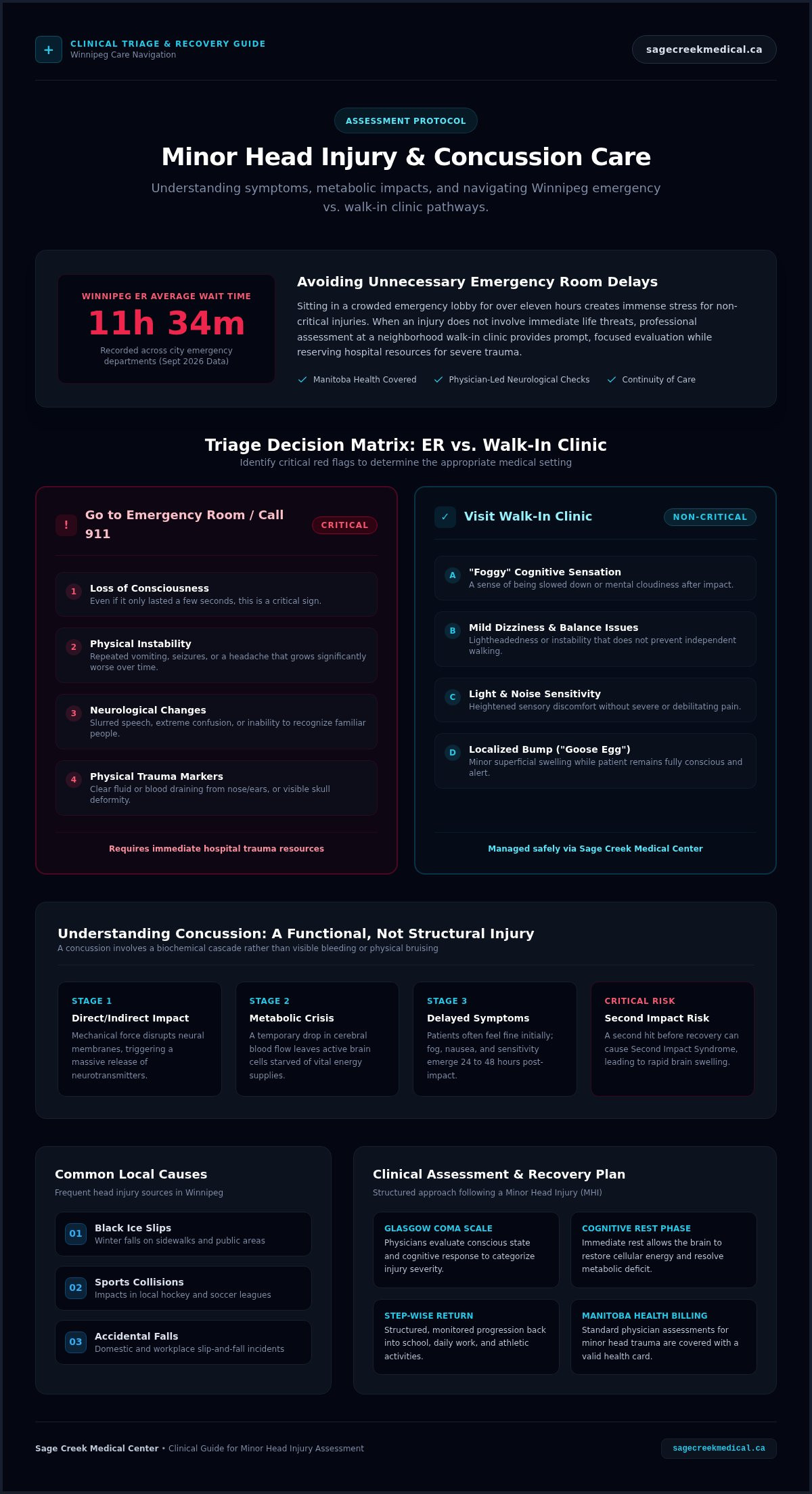
A concussion is a functional rather than structural injury. Instead of physical bleeding or bruising, the brain experiences a metabolic crisis. The impact causes a massive release of neurotransmitters and a temporary drop in blood flow, leaving brain cells starved for energy. This is why symptoms don’t always appear immediately. It’s common for a person to feel fine for several hours, only to experience intense fog, nausea, or light sensitivity 24 to 48 hours later. When you seek an assessment for minor head injury in Winnipeg, our physicians look for these metabolic signs rather than just physical trauma.
The Importance of Prompt Assessment
We prioritize quick evaluations to rule out rare but dangerous complications like Second Impact Syndrome. This occurs when a second injury happens before the first has fully healed, which can lead to rapid brain swelling. Our team at Sage Creek Medical Center works with you to track symptoms over time, providing the continuity of care that a busy ER simply can’t offer. Most physician visits for these concerns are covered, and you can learn more about how to use your health card in our Manitoba Health guide. Having an experienced family doctor monitor your progress ensures that your recovery stays on track and that you don’t return to work or sports too early.
Red Flags: When to Choose a Winnipeg Walk-In vs. the ER
Choosing between a long wait at the hospital and a visit to a local clinic is a decision many Winnipeg families face. With recent September 2026 data showing average ER wait times across the city reaching 11 hours and 34 minutes, we want to help you make the safest choice for your loved ones. While some injuries are clear emergencies, many others are best handled in a community setting where we can provide focused, person-centered care. Our clinic helps you avoid the high-stress environment of a hospital when your situation is non-life-threatening.
Go to the Emergency Room If…
Certain symptoms indicate a potential traumatic brain injury that requires hospital resources. If you or someone you’re caring for experiences any of the following, please call 911 or head to the nearest emergency department immediately:
- Loss of consciousness: Even if it only lasted a few seconds, this is a critical sign.
- Physical instability: Repeated vomiting, seizures, or a headache that grows significantly worse over time.
- Neurological changes: Slurred speech, difficulty recognizing familiar people, or extreme confusion.
- Physical trauma: Clear fluid or blood draining from the nose or ears, or a visible skull deformity.
Visit Our Walk-In Clinic If…
If the injury seems less severe but you’re still concerned, our team is ready to help. An assessment for minor head injury in Winnipeg is appropriate for symptoms that are bothersome but not immediately dangerous. You should see us if you experience:
- A “foggy” feeling or a sense of being slowed down.
- Mild dizziness or balance issues that don’t prevent you from walking.
- Sensitivity to light or noise without severe, debilitating pain.
- Minor bruising or a “goose egg” on the head while remaining fully alert.
You can learn more about how to navigate these visits in our Walk-In Clinic Winnipeg guide. We ensure that your concerns are heard and that you receive the right level of care without unnecessary delay.
For years, many were told to just “wait and watch” at home. We now know that professional eyes are essential for catching subtle metabolic changes early. A professional assessment for minor head injury in Winnipeg ensures that symptoms aren’t ignored until they become chronic problems. We act as a vital bridge in the healthcare system, offering the clinical authority you need without the stress of an overcrowded waiting room. If you’re unsure about your symptoms, our experienced family physicians are here to provide a thorough evaluation and a clear path forward for your recovery.
What to Expect During Your Clinical Assessment in Winnipeg
When you walk into our clinic for an assessment for minor head injury in Winnipeg, the process begins with a careful triage. We prioritize your comfort and safety from the moment you arrive. Our team starts by reviewing your medical history, specifically looking for any previous head injuries or pre-existing conditions that might influence your recovery. This initial conversation helps us understand the context of the impact and how your symptoms have evolved since the incident occurred.
In 2026, we utilize the SCAT6 (Sport Concussion Assessment Tool 6), which is the current gold standard for evaluating suspected concussions in both athletes and the general public. This standardized tool helps us gather objective data on your symptoms, cognitive function, and physical reactions. By using a consistent framework, we can provide a more accurate diagnosis and track your progress more effectively over the coming weeks.
The Neurological Exam
We perform a series of non-invasive tests to see how your brain is communicating with your body. We check your pupil response to light, assess your balance, and test your coordination through simple physical movements. We also evaluate your memory and concentration by asking you to recall specific strings of numbers or words. It is important to remember that most minor head injuries do not require X-rays, as these scans only show bone fractures rather than the functional metabolic changes occurring in the brain.
We only recommend advanced imaging like CT scans or MRIs if we suspect structural damage, such as a brain bleed or skull fracture. For the vast majority of patients seeking an assessment for minor head injury in Winnipeg, these intensive tests aren’t necessary. Our goal is to provide a thorough evaluation that gives you peace of mind without exposing you to unnecessary radiation or the stress of a hospital environment.
Manitoba Health Coverage for Assessments
We want to ensure that accessing quality care is as stress-free as possible for our neighbors. Your clinical assessment is a medically necessary service covered by Manitoba Health for residents with a valid health card. If you need documentation for your employer or school, such as a sick note or a medical certificate to justify time off for recovery, we can provide these during your visit. For more information on how we maintain these high standards of patient care, you can read our guide on Choosing the Right Health Clinic in Winnipeg. We take pride in being a reliable pillar of the community, ensuring every individual receives the personalized attention they deserve.
Recovery and Home Care Following a Minor Head Injury
Once your clinical assessment for minor head injury in Winnipeg is complete, the focus shifts to the domestic unit and the healing process. We believe that recovery is a collaborative effort between our medical team and your family. The most vital component of early recovery is “Cognitive Rest.” This means more than just lying in a dark room; it involves limiting mental strain from smartphones, video games, and even intensive reading for the first 48 hours. By reducing the metabolic demand on your brain, you allow it to prioritize healing.
In 2026, we follow a refined step-wise approach for returning to daily life. You shouldn’t jump back into full work days or sports immediately. Instead, we guide you through gradual stages, starting with light daily activities and slowly increasing duration and intensity only when symptoms don’t return. If a headache or nausea flares up, it’s a signal from your body to step back to the previous stage for at least 24 hours. This methodical pace is the most reliable way to ensure a full and lasting recovery.
The Role of the Sage Creek Pharmacy
Managing symptoms like pain and nausea is a delicate balance. We often recommend specific over-the-counter medications, but it’s crucial to avoid certain blood thinners immediately after an injury unless directed otherwise by our physicians. Our on-site pharmacy makes this process seamless. You can fill your prescriptions immediately after your walk-in visit, ensuring you have the right support without extra travel. For those who need to remain at home to rest, we offer free city-wide delivery. This service ensures you stay comfortable while receiving professional pharmaceutical care. You can find more details on medication safety in our guide on Choosing a Pharmacy in Winnipeg.
Monitoring at Home
The first 24 hours are the most significant for observation. We encourage partners and parents to look for changes in mood, increased confusion, or worsening physical symptoms. A common concern is whether it’s safe to let an injured person sleep. Current medical consensus confirms that sleep is beneficial for recovery, provided the person can be easily awakened and isn’t showing the red flags we discussed earlier. We prioritize your peace of mind by providing clear instructions on what to watch for during the night.
We generally recommend a follow-up visit within one to two weeks to ensure your recovery is progressing as expected. If you have questions about your home care plan or need to schedule a review after your initial assessment for minor head injury in Winnipeg, please contact our team today to speak with one of our caring professionals. We are here to support you through every phase of your healing journey.
Why Choose Sage Creek Medical Center for Head Injury Assessment
Our clinic is more than just a medical facility; we’re a dedicated part of the Sage Creek neighborhood. We’ve designed our modern space to feel like a safe, accessible, and person-centered environment that lowers the anxiety often felt during medical visits. Choosing Sage Creek Medical Center for your assessment for minor head injury in Winnipeg means you’re trusting a team that values long-term relationships and treats every patient as an individual. We combine clinical authority with a neighborly warmth that makes a significant difference when you’re feeling vulnerable.
One of the greatest benefits we offer is the seamless integration of services. By housing family medicine consultations, walk-in care, and an on-site pharmacy under one roof, we eliminate the need for multiple stressful trips across the city. This organized approach reflects our commitment to holistic health and reliability. We ensure that your journey from the initial evaluation to picking up necessary medications is steady and calm, allowing you to focus entirely on your recovery at home.
Experienced Winnipeg Physicians
Our team consists of experienced family physicians who are deeply familiar with Manitoba Health protocols. We provide inclusive, empathetic care for both pediatric and adult head injuries, ensuring that every member of the domestic unit is supported. Our doctors have expertise that extends beyond simple consultations to include minor surgical procedures and chronic disease management. This broad clinical background allows us to spot subtle issues that others might miss. If your condition requires specialized intervention, we coordinate directly with specialists to ensure your care remains consistent and thorough.
Easy Access and Booking
We understand that timing is critical when you suspect a concussion. Our walk-in clinic services are available for urgent but non-emergency situations, providing a faster alternative to the local emergency departments. For those who aren’t currently matched with a primary care provider, we also offer the opportunity to register for our waitlist. We aim to be a reliable pillar of support throughout all phases of your life, offering professional practice that is both technologically current and deeply grounded in the community. We invite you to reach out to us for a quiet, confident, and professional assessment for minor head injury in Winnipeg.
Book your assessment or visit our walk-in clinic today.
Moving Forward with Confidence and Care
Protecting your long-term health after a head impact means replacing uncertainty with clear, professional guidance. By recognizing subtle symptoms early and following a structured home care plan, you ensure your brain has the exact environment it needs to heal. Obtaining a timely assessment for minor head injury in Winnipeg is the most reliable way to safeguard your well-being and protect your family from unnecessary stress.
You don’t have to navigate the recovery process alone. Our empathetic, community-focused medical team provides comprehensive care within a modern facility, complete with an on-site pharmacy for your convenience. Every step of your visit is aligned with Manitoba Health standards, ensuring accessible care right here in your neighborhood. We invite you to visit Sage Creek Medical Center for a professional head injury assessment today, so we can help you return to your favorite local routines safely and comfortably.
Frequently Asked Questions
How long should I wait to see a doctor after a head injury?
You should seek medical attention as soon as possible, ideally within the first few hours following the impact. While some symptoms appear instantly, others might not manifest for 24 to 48 hours. Early intervention helps rule out more serious complications and allows us to establish a baseline for your recovery. If you experience a non-emergency bump, visiting our clinic for an assessment for minor head injury in Winnipeg ensures you get professional eyes on the problem without the long hospital wait.
Does Manitoba Health cover concussion assessments at a walk-in clinic?
Yes, Manitoba Health covers the cost of medically necessary physician consultations for residents with a valid health card. This includes the clinical evaluation and neurological testing required to diagnose a suspected concussion. We handle the billing directly with the province, so there are no out-of-pocket fees for the assessment itself. We believe that quality healthcare should be accessible to everyone in our community, ensuring you receive the support you need during your recovery journey.
Can a walk-in clinic perform a CT scan for a head injury?
Walk-in clinics don’t have on-site CT scan equipment, as these advanced imaging tools are located in hospitals. Our physicians perform thorough neurological exams to determine if a scan is clinically necessary. If we suspect a more serious structural injury, such as a brain bleed, we’ll coordinate your referral to the appropriate facility. Most minor injuries are functional rather than structural and don’t require radiation-based imaging for a proper diagnosis and recovery plan.
What is the difference between a minor head injury and a concussion?
A minor head injury is a broad category that includes any non-life-threatening trauma to the scalp, skull, or brain. A concussion is a specific type of mild traumatic brain injury that affects how your brain functions rather than its physical structure. While all concussions are considered head injuries, not every bump to the head results in one. Our team provides a precise assessment for minor head injury in Winnipeg to distinguish between these conditions and provide tailored care.
How much does a sick note cost for a head injury in Winnipeg?
Medical certificates and sick notes for employers or schools are considered uninsured services not covered by Manitoba Health. In 2026, standard fees for these documents at Winnipeg clinics typically range around C$30. We provide these notes during your visit to help you secure the necessary time off for cognitive rest. Having formal documentation ensures your workplace or school understands your recovery requirements and the specific limitations needed to help your brain heal properly.
What are the most common concussion symptoms in children?
Children often express symptoms differently than adults, so it’s important to watch for changes in their normal behavior. Common signs include increased irritability, changes in sleep patterns, or a sudden loss of interest in favorite activities. Physical symptoms like persistent headaches, nausea, or sensitivity to light are also frequent indicators. Our pediatric care team takes a gentle, empathetic approach to help young patients feel safe and comfortable while we evaluate their condition and support their unique recovery needs.
Is it safe to drive myself to the clinic after hitting my head?
It’s not safe to drive yourself to the clinic if you’ve sustained a head injury. Impact can cause delayed dizziness, blurred vision, or slowed reaction times that significantly impair your ability to operate a vehicle safely. We strongly recommend having a family member, friend, or neighbor drive you to your appointment. If you’re alone and experiencing any symptoms of confusion or physical instability, it’s best to call for transport to ensure you arrive safely for your evaluation.
What should I bring to my assessment at Sage Creek Medical Center?
Please bring your valid Manitoba Health card and a list of any current medications or supplements you’re taking. It’s also helpful to have a brief timeline of the injury, including when it happened and what symptoms you’ve noticed since. If a witness saw the incident, having them join you can provide valuable context for our physicians. We strive to make your visit as organized and efficient as possible, ensuring you leave with a clear recovery plan.