
Finding a family doctor accepting patients in Winnipeg can feel like searching for something that simply doesn’t exist. You’ve made the calls, hit the waitlists, and wondered whether consistent, personal medical care is even within reach. You’re not alone in that frustration, and it’s a completely fair one to have.
Here’s what many people don’t realize: the right family doctor isn’t just someone who sees you when you’re sick. They’re the person who knows your history, coordinates your care, and becomes a trusted constant through every stage of your life. That kind of relationship is worth finding, and it’s more accessible in Winnipeg than you might think.
This guide is here to help. We’ll walk you through practical steps for finding a family doctor in Winnipeg who’s currently welcoming new patients, explain what services you can expect, and show you how clinics like Sage Creek Medical Center are making it easier to access everything from family medicine to on-site prescription dispensing, all under one roof, close to home.
Key Takeaways
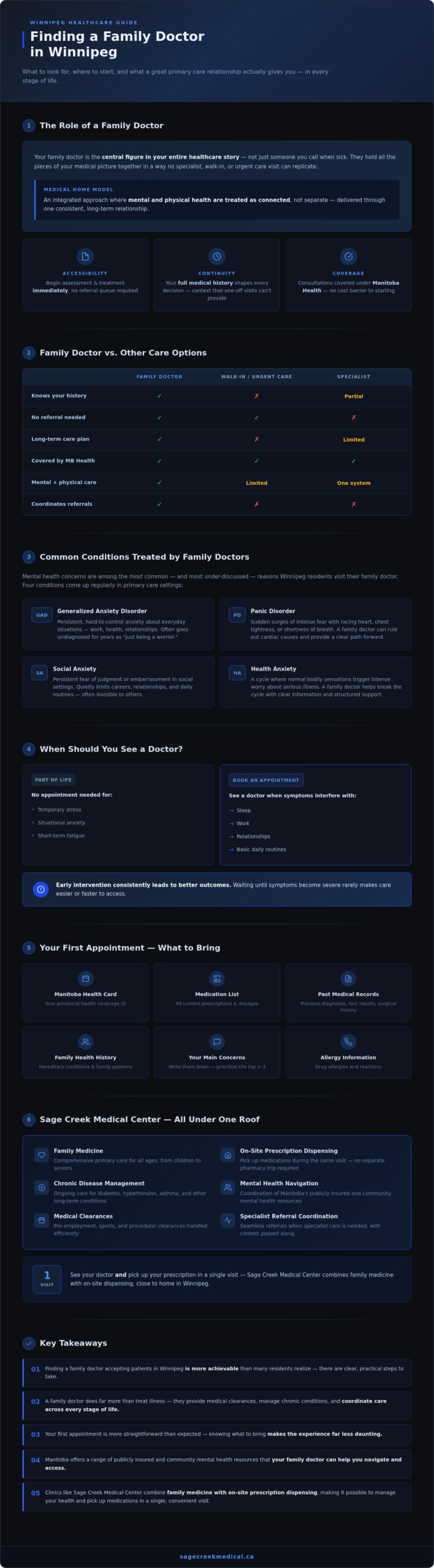
- Finding a family doctor accepting patients in Winnipeg is more achievable than many residents realize – this guide walks you through exactly where to look and what steps to take.
- A family doctor does far more than treat illness; they provide medical clearances, manage chronic conditions, and coordinate your care across every stage of life.
- Your first appointment is more straightforward than you might expect – knowing how to prepare and what to bring can make the entire experience feel far less daunting.
- Manitoba offers a range of publicly insured and community mental health resources that your family doctor can help you navigate and access.
- Clinics like Sage Creek Medical Center combine family medicine with on-site prescription dispensing, making it possible to manage your health and pick up medications in a single, convenient visit.
The Role of a Family Doctor in Winnipeg
Your family doctor is rarely just the person you call when something feels off. They’re the central figure in your entire healthcare story. In Winnipeg’s medical landscape, a family physician serves as your first point of contact, your long-term health advocate, and the professional who holds all the pieces of your medical picture together. That coordination role is something no specialist, walk-in visit, or urgent care appointment can fully replicate.
When a new symptom appears, a family doctor doesn’t just treat what’s visible. They consider your history, your lifestyle, your previous test results, and what’s changed. That context is what turns a good appointment into genuinely useful care. A specialist, by contrast, typically sees one system or one condition. Your family doctor sees you.
This is the foundation of what’s known as the Medical Home model, an approach to primary care where both mental and physical health are treated as connected rather than separate. Under this model, your GP can identify when persistent fatigue might be tied to a thyroid issue, when anxiety symptoms warrant a physical workup before a referral, or when a lifestyle change could reduce the need for medication entirely. It’s integrated, whole-person care delivered from a single, consistent relationship.
Why Start with Primary Care?
There are three practical reasons to begin with a family doctor rather than seeking a specialist directly:
- Accessibility: Specialists in Manitoba typically require a referral, and wait times can stretch considerably. A family doctor can begin assessment and treatment immediately, without a referral queue.
- Continuity: Your doctor knows your full medical history. That context shapes every decision they make on your behalf.
- Coverage: Consultations with a family physician are covered under Manitoba Health, meaning there’s no cost barrier to starting the conversation.
For anyone searching for a family doctor accepting patients in Winnipeg, this accessibility point matters. Primary care is the most direct route into the healthcare system, and it’s often the most effective one.
When to See a Doctor?
Not every difficult week requires a medical appointment. Temporary stress, situational anxiety, and short-term fatigue are part of life. But when symptoms begin interfering with daily function, whether that’s sleep, work, relationships, or basic routines, that’s a meaningful signal worth taking seriously.
Early intervention consistently leads to better outcomes. A family doctor can distinguish between a temporary response to circumstances and a clinical condition that benefits from structured support. That distinction matters, because the right next step looks very different depending on the answer. Waiting until symptoms become severe rarely makes care easier or faster to access.
Finding a family doctor accepting patients in Winnipeg isn’t just about having someone to call when you’re unwell. It’s about having a trusted professional who can catch things early, connect the dots, and help you stay ahead of your health rather than constantly catching up to it.
Common Health Issues Treated by Winnipeg Family Doctors
Mental health concerns are among the most common reasons Winnipeg residents visit their family doctor, yet they’re also among the most under-discussed. A good family physician doesn’t wait for a crisis. They recognize patterns, ask the right questions, and help you understand what’s actually happening before symptoms become harder to manage.
Four conditions come up regularly in primary care settings across the city:
- Generalized Anxiety Disorder (GAD): This isn’t occasional worry. GAD involves persistent, difficult-to-control anxiety about everyday situations, work, health, relationships, and finances, often without a clear trigger. It’s exhausting to live with, and it frequently goes undiagnosed for years because it can feel like simply being “a worrier.”
- Panic Disorder: Sudden surges of intense fear accompanied by physical symptoms like racing heart, chest tightness, or shortness of breath. Many people end up in urgent care convinced something is physically wrong. A family doctor can rule out cardiac causes and provide a clear path forward.
- Social Anxiety: More than shyness, social anxiety involves a persistent fear of judgment or embarrassment in social settings. It can quietly limit careers, relationships, and daily routines in ways that aren’t always obvious to others or even to the person experiencing it.
- Health Anxiety: A cycle where normal bodily sensations trigger intense fear of serious illness. Reassurance helps briefly, then the worry returns. A family doctor is uniquely positioned to break that cycle through both clinical assessment and consistent, trustworthy communication.
Each of these conditions is treatable. Early, consistent primary care makes a measurable difference in outcomes.
Screening Tools Used in Clinics
Family doctors don’t rely on intuition alone. The GAD-7 scale is a validated, seven-question screening tool used to measure the severity of anxiety symptoms and track changes over time. Alongside this, physicians conduct physical examinations to rule out conditions that can mimic anxiety, including thyroid disorders, cardiovascular irregularities, and hormonal imbalances. A thorough mental health history and collaborative goal-setting round out the initial assessment, giving both patient and doctor a shared starting point rather than a one-size-fits-all plan.
Supporting New Parents
Perinatal and postpartum anxiety affect a significant number of new parents, yet they’re frequently dismissed as normal adjustment stress. A family doctor accepting patients in Winnipeg can screen for these conditions during prenatal visits and postpartum checkups, offer direct support or referrals, and integrate pediatric care with maternal wellness so that both parent and child are seen as part of the same picture. That continuity matters enormously during one of life’s most demanding transitions.
If any of these experiences feel familiar, connecting with a trusted local provider is a practical first step. The team at Sage Creek Medical Center offers family medicine rooted in whole-person care, close to home.
What to Expect During Your Doctor Visit
For many people, the hardest part of seeing a family doctor isn’t the appointment itself. It’s the uncertainty beforehand. Not knowing what questions will be asked, whether your concerns will be taken seriously, or what happens after you walk out the door. Knowing what to expect makes the entire experience feel far more manageable.
Before you arrive, take a few minutes to write down your symptoms, when they started, what makes them better or worse, and any questions you want answered. That simple preparation changes the quality of the conversation significantly. It helps your doctor understand the full picture quickly, and it ensures you don’t leave having forgotten something important.
The 4-Step Consultation Process
Most family medicine appointments follow a clear, logical sequence:
- Medical history and symptom review: Your doctor will ask about your current concerns alongside your broader health background, medications, family history, and lifestyle. This context shapes everything that follows.
- Screening questionnaire: For concerns like anxiety or mood, a validated tool such as the GAD-7 may be used to establish a baseline and track changes over time.
- Discussion of treatment options: This is a conversation, not a prescription handed across a desk. Your preferences, concerns, and circumstances all factor into what comes next.
- Referral to additional resources if needed: If specialist care, community mental health support, or other services are appropriate, your doctor will coordinate that referral directly.
Care doesn’t end when the appointment does. Follow-up planning is built into the process because most health concerns, whether chronic conditions, mental health, or ongoing medication management, require consistent monitoring over time. A single visit is a starting point, not a finish line.
Discussing Medication
Medication conversations can feel intimidating, especially when terms like SSRIs come up. These are commonly prescribed for anxiety and mood-related conditions, and your doctor will explain how they work, what to realistically expect during the adjustment period, and how to recognize side effects worth reporting. The goal is informed decision-making, not compliance.
Concerns about side effects are completely normal and worth raising directly. An honest conversation upfront prevents unnecessary worry later.
This is where having an on-site pharmacy makes a genuine difference. At a clinic like Sage Creek Medical Center, you can speak with a pharmacist immediately after your appointment, ask follow-up questions about your prescription, and leave with both a clear care plan and your medication in hand. For anyone searching for a family doctor accepting patients in Winnipeg, that kind of integrated, same-visit convenience removes one more barrier between a decision and action.
Exploring Mental Health Resources in Manitoba
Manitoba’s publicly funded healthcare system covers more than most residents realize. Under Manitoba Health, consultations with a family physician for mental health concerns are fully insured, meaning there’s no out-of-pocket cost to begin that conversation. That’s a meaningful starting point for anyone who has been putting off seeking support because of financial uncertainty.
Beyond your doctor’s office, the Anxiety Disorders Association of Manitoba (ADAM) offers community-based programs, peer support groups, and educational resources specifically for people living with anxiety-related conditions. These services complement clinical care rather than replacing it, and your family doctor can help you figure out which combination makes the most sense for your situation.
This is precisely why finding a family doctor accepting patients in Winnipeg matters so much. Community resources are valuable, but they work best when someone is coordinating the full picture. A consistent physician knows which programs align with your needs, can monitor your progress across multiple supports, and adjusts your care plan as things change.
Referrals to Specialists
A referral to a psychiatrist or psychologist doesn’t mean your family doctor is stepping back. It means they’re expanding your team. In Winnipeg, specialist wait times can vary considerably depending on the condition and the provider, so your GP will often begin assessment and initial treatment while the referral is in progress. Throughout that process, your family doctor remains your home base, receiving updates, managing medications, and keeping your care coordinated rather than fragmented.
Community Support and Self-Help
Winnipeg has a quiet but genuine network of mental health supports worth knowing about:
- ADAM’s self-help programs: Structured group sessions for anxiety and related conditions, often available at low or no cost.
- Manitoba’s Here to Help resources: Reliable online information and self-assessment tools for a range of mental health concerns.
- Walk-in clinics: When you’re between family medicine appointments and something feels urgent, a walk-in visit can provide bridge care, a short-term prescription review or a referral to tide you over until your next scheduled appointment.
It’s worth being direct about what walk-in care can and can’t do. It’s useful for immediate concerns, but it doesn’t replace the continuity that comes from a physician who knows your full history. Think of it as a bridge, not a destination.
If you’re ready to build that longer-term relationship with a provider who understands your whole health picture, the team at Sage Creek Medical Center offers family medicine and walk-in services close to home, with an on-site pharmacy that makes follow-through on your care plan that much simpler.
Sage Creek Medical Center: Your Healthcare Partner
Everything covered in this guide, the value of continuity, the importance of coordinated care, the difference a trusted physician makes over time, comes together in one place when you find a clinic that genuinely understands what patients need. Sage Creek Medical Center was built around exactly that understanding. It’s a modern, community-rooted facility designed to feel less like a medical institution and more like a neighborhood resource you can actually rely on.
The environment matters more than people often acknowledge. Walking into a calm, welcoming space reduces the low-level dread that keeps many people from booking appointments in the first place. At Sage Creek, that atmosphere is intentional. The goal is straightforward: make it easier to show up, ask the honest questions, and leave with a clear path forward.
Care options here span the full range of what a family needs. Whether you’re looking for a family doctor accepting patients in Winnipeg for long-term primary care, need a walk-in visit for something more immediate, or require chronic disease management, pediatric care, women’s health services, or minor surgical procedures, it’s all available under one roof. You’re not piecing together care from multiple disconnected providers. You’re building something coherent.
Integrated Pharmacy Services
The on-site pharmacy at Sage Creek is where the convenience becomes genuinely practical. After your appointment, a pharmacist is available for confidential counseling, answering questions about your prescription, explaining what to expect, and flagging anything worth discussing before you leave. Prescription refills can be synced with your scheduled appointments so you’re never caught running out between visits. For those who can’t make it in person, free city-wide prescription delivery means your medications come to you.
This is the gap that most clinics leave open. Seeing a doctor is one step; actually following through on the care plan is another. Having both in the same visit removes that gap entirely.
Join the Sage Creek Community
Registering as a new patient is a straightforward process. The team at Sage Creek is committed to building long-term relationships with the families in this community, not just managing isolated appointments. That commitment means your care grows with you, from pediatric visits and prenatal checkups through to chronic condition management and everything in between.
If you’ve been searching for a family doctor accepting patients in Winnipeg and wondering whether consistent, personal care is actually within reach, this is your answer. Book your consultation at Sage Creek Medical Center today.
Your Next Step Toward Consistent, Connected Care
Consistent, personal healthcare isn’t a luxury. It’s the foundation that makes everything else, managing a chronic condition, navigating a mental health concern, keeping your family healthy through every stage of life, actually work. This guide has walked you through what a family doctor genuinely does, what to expect when you walk through the door, and what support exists in Manitoba beyond the clinic itself.
The clearest takeaway is this: finding a family doctor accepting patients in Winnipeg is achievable, and the right provider makes a measurable difference over time. A clinic that combines family medicine with walk-in flexibility and an on-site pharmacy with free city-wide delivery removes the friction that too often stands between a good intention and real follow-through.
Sage Creek Medical Center is currently welcoming new patients and walk-ins, close to home, with everything you need in one visit. Don’t put it off any longer. Book your appointment at Sage Creek Medical Center today and take the first step toward healthcare that actually works for you.
Frequently Asked Questions
Can a family doctor in Winnipeg prescribe medication for anxiety?
Yes, family doctors in Winnipeg are fully qualified to assess and prescribe medication for anxiety disorders. This commonly includes SSRIs or SNRIs, which are first-line treatments for conditions like generalized anxiety disorder and panic disorder. Your doctor will explain what to expect during the adjustment period and schedule follow-up appointments to monitor how the medication is working for you.
Having an on-site pharmacy, like the one at Sage Creek Medical Center, means you can speak directly with a pharmacist after your appointment to clarify dosage, timing, and any concerns before you leave the building.
Does Manitoba Health cover therapy or counseling sessions?
Manitoba Health covers consultations with your family physician for mental health concerns, but it does not typically cover private psychologist or therapist sessions. Publicly funded options do exist through community mental health programs, and your family doctor can refer you to these services. Some employers also provide coverage through workplace benefit plans, so it’s worth checking what your plan includes.
Your family doctor is the best starting point for navigating what’s covered and what community programs might reduce or eliminate out-of-pocket costs for additional support.
What is the difference between a family doctor and a psychiatrist for anxiety?
A family doctor provides ongoing, whole-person care and is usually your first point of contact for anxiety. They can diagnose, prescribe medication, and refer you to specialists when needed. A psychiatrist is a medical specialist focused specifically on complex or treatment-resistant mental health conditions and typically requires a referral to access in Manitoba.
For most people managing anxiety, a family doctor is both the appropriate and most accessible starting point. Psychiatric care becomes part of the picture when a condition requires more specialized assessment or medication management than primary care can provide.
Should I go to a walk-in clinic for an anxiety attack?
If you’re experiencing chest pain, difficulty breathing, or symptoms you can’t distinguish from a cardiac event, seek emergency care immediately. For anxiety attacks where you’re not in physical danger but need same-day support, a walk-in clinic can help rule out physical causes, provide short-term guidance, and bridge the gap until you have an appointment with a family doctor.
Walk-in care is useful in the moment, but it works best as a temporary measure. A family doctor accepting patients in Winnipeg can provide the consistent, ongoing support that actually reduces the frequency and intensity of anxiety episodes over time.
How do I talk to my doctor about anxiety if I’m nervous?
Start simple: tell your doctor you’ve been struggling and want to talk about it. You don’t need to arrive with a perfectly organized explanation. Writing down two or three specific things you’ve noticed, such as sleep disruption, persistent worry, or physical tension, gives you something concrete to refer to if the words don’t come easily in the moment.
Doctors have these conversations regularly, and a good family physician won’t rush you or minimize what you’re describing. If something feels unclear or you’re unsure whether your symptoms are “serious enough,” say that directly. Honesty about your uncertainty is just as useful as a clear description of symptoms.
What if my family doctor isn’t accepting new patients right now?
This is a common situation in Winnipeg, and it doesn’t mean consistent care is out of reach. Some clinics actively welcome new patients, so it’s worth contacting providers directly rather than assuming availability based on general reputation. Manitoba’s Health Links program can also help connect you with primary care options in your area.
In the meantime, walk-in services at clinics like Sage Creek Medical Center allow you to access care without an established patient relationship, which can provide meaningful support while you secure longer-term family medicine coverage.
Can anxiety cause physical symptoms like chest pain or dizziness?
Yes, anxiety regularly produces physical symptoms, and this is one of the most important reasons to see a family doctor rather than self-diagnosing. Chest tightness, dizziness, shortness of breath, nausea, and muscle tension are all well-documented physical responses to anxiety. The challenge is that these symptoms overlap with other conditions that require different treatment entirely.
A family doctor can run appropriate tests to rule out cardiac, respiratory, or hormonal causes before confirming an anxiety-related diagnosis. That clinical process isn’t unnecessary caution; it’s what makes the diagnosis and the treatment plan trustworthy.
How long does it take for anxiety treatment to start working?
It depends on the treatment. Therapeutic approaches like cognitive behavioural techniques may produce noticeable changes within a few weeks of consistent practice. Medication, particularly SSRIs, typically takes four to six weeks before the full effect becomes clear, and the first few weeks can involve a brief adjustment period before improvement is felt.
Your family doctor will set realistic expectations from the start and schedule follow-up appointments to track your progress. If a particular approach isn’t producing results, there are alternatives worth exploring. Treatment for anxiety is rarely a single fixed path; it’s an ongoing conversation between you and your doctor.