
Did you know that at age 50, a healthy woman faces nearly a 50% risk of experiencing an osteoporotic fracture in her lifetime? It’s a startling statistic that often brings up a lot of “what ifs” about future mobility and independence. If you’ve been feeling anxious about silent symptoms or are simply unsure how to access osteoporosis screening in Winnipeg, you aren’t alone. We understand that navigating the healthcare system can feel overwhelming, especially when you’re worried about your long term bone health and the fear of a sudden injury.
We believe that proactive care should be accessible and clear for everyone in our community. In this guide, we’ll walk you through the 2026 Manitoba Health screening guidelines and explain exactly how the referral process works for a DEXA scan. You’ll learn about the specific risk factors that might require earlier testing, such as a previous fracture or certain lifestyle indicators, and how to work with your family physician to create a personalized plan. We’ll also preview what to expect during your appointment so you can move forward with confidence and clarity.
Key Takeaways
- Understand why early screening is vital for identifying “silent” bone density loss before a fracture occurs.
- Identify if you meet the 2026 eligibility criteria for screening based on your age or specific high-risk health factors.
- Discover how to access osteoporosis screening winnipeg through the quick, non-invasive DEXA scan process.
- Learn the steps to obtain a physician referral so your bone density testing is covered by Manitoba Health.
- Explore how our community clinic provides integrated care, from initial family medicine consultations to on-site pharmacy support.
What is Osteoporosis Screening and Why is it Essential?
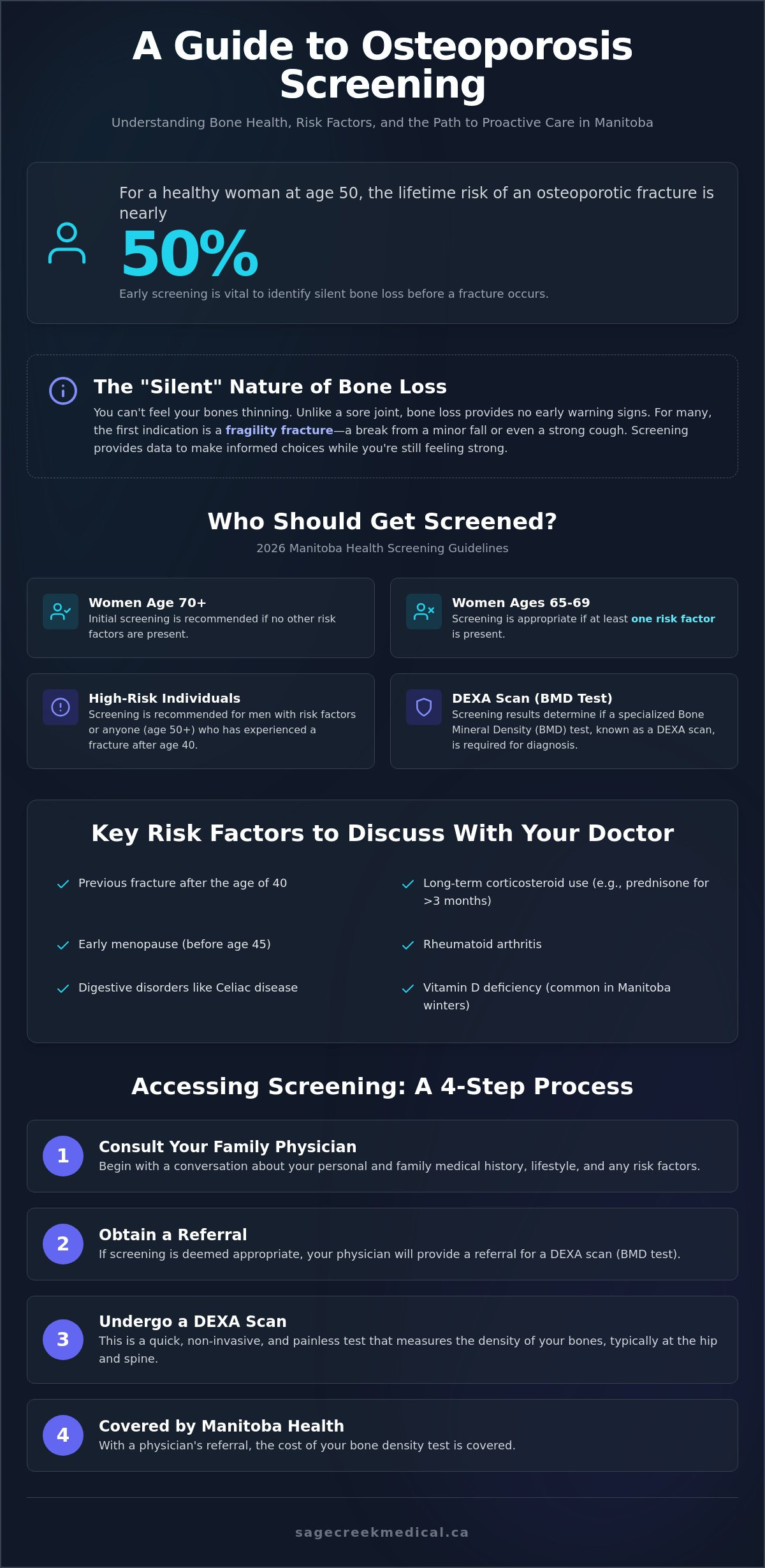
Understanding What is Osteoporosis is the first step in taking control of your long term health. It’s a condition where bones become thin and porous, losing their strength over time. Because this happens deep within the skeletal structure, many people don’t realize their bones are weakening until a minor slip or fall leads to a painful break. This is why osteoporosis screening winnipeg is such a vital tool for our community. It allows us to look beneath the surface and identify risks before they impact your daily life or your ability to stay active in our neighborhood. By the time a woman reaches age 50, she faces nearly a 50% risk of an osteoporotic fracture; screening helps us change that trajectory.
The “Silent” Nature of Bone Loss
You can’t feel your bones thinning. Unlike a sore joint or a muscle strain, bone loss doesn’t send out early warning signals. For many, the first sign is a fragility fracture, which is a break that occurs from a movement that wouldn’t normally cause injury, like tripping on a carpet or even a strong cough. We want to help you avoid that surprise. Screening is a gentle, proactive measure that replaces uncertainty with data. It gives you the power to make informed choices about your lifestyle and nutrition while you’re still feeling strong. Our team views this as a foundational part of aging gracefully within the Sage Creek community.
Screening vs. Diagnosis
It’s helpful to distinguish between these two steps. Screening is about identifying your level of risk. It’s the starting point where we look at your history and bone density to see if you’re on a path toward future issues. A formal diagnosis follows if the results show a bone density T-score of 2.5 or more standard deviations below the average peak young adult density. Effective preventive care starts with a simple conversation at our clinic. By scheduling an osteoporosis screening winnipeg consultation, you’re taking a key step in chronic disease management. Our physicians use these screenings to determine if you need a specialized Bone Mineral Density (BMD) test. The 2026 Manitoba guidelines suggest that women without extra risk factors should begin screening at age 70, though those with a previous fracture or specific history might start as early as 50. We’re here to help you figure out exactly where you fit in that timeline, ensuring we catch potential problems early enough to preserve your independence.
Determining the right time for osteoporosis screening winnipeg depends on your unique health profile and history. As of March 2026, Manitoba health guidelines recommend initial screening for women at age 70 if no other risk factors are present. However, if you have even one risk factor, screening is appropriate between ages 65 and 69. For men, screening is typically recommended when at least one risk factor is present. Following the Canadian Osteoporosis Screening Guidelines helps us ensure you receive the right care at the right time. If you’ve already experienced a fracture after age 40, we should begin this conversation much sooner.
Living in Manitoba brings unique challenges to our bone health that we need to consider together. Our long, dark winters often lead to Vitamin D deficiency, which is essential for calcium absorption and bone strength. We frequently see patients who are surprised to learn that their indoor lifestyle during the coldest months can impact their skeletal durability. We recommend discussing your Vitamin D levels during a routine family medicine consultation to see if your body is getting enough support to maintain its density through every season.
Risk Factors You Should Discuss with Your Doctor
Certain medical conditions and medications can accelerate bone loss without you realizing it. if you’ve been prescribed corticosteroids like prednisone for more than three months, your risk for low bone density increases. We also pay close attention to patients managing rheumatoid arthritis or digestive disorders like celiac disease, as these can interfere with how your body absorbs nutrients and maintains bone mass. Sharing your full medical history with us allows our team to provide a more accurate and reassuring assessment of your needs.
The Importance of Early Menopause Screening
For many women, the transition into menopause marks a period of rapid bone loss due to declining estrogen levels. This is why our women’s health services in Winnipeg prioritize bone health discussions as soon as you enter your 50s. Catching these changes early can make a massive difference in your long term mobility. We encourage you to bring up osteoporosis screening winnipeg during your annual check-up so we can establish a baseline for your health. Early intervention can effectively slow or stop bone loss before it leads to a life-altering injury, helping you stay active and independent for years to come.
The Screening Process: DEXA Scans and Bone Density Testing
The gold standard for osteoporosis screening winnipeg is the DEXA scan, which stands for Dual-Energy X-ray Absorptiometry. While the name sounds technical, the experience is remarkably simple and stress-free. We want to reassure you that this isn’t a procedure involving needles, contrast dyes, or uncomfortable enclosures. Instead, you’ll lie on a padded table while a scanner passes over your body, typically focusing on your hip and spine. The entire process is usually completed in about 15 to 20 minutes. Once the scan is finished, the results are sent back to your Winnipeg clinic, where our team will review the findings with you during a follow-up visit.
According to the Public Health Agency of Canada on Osteoporosis, these scans are the most accurate way to measure bone mineral density. They help us see how much bone mass you have compared to a healthy young adult of the same gender. It’s a vital part of our collaborative care model, ensuring we have precise data to support your health throughout all phases of life. By measuring your bone density now, we can establish a baseline that helps us track changes over the coming years.
How to Prepare for Your Appointment
Preparing for your scan is straightforward and requires very little change to your routine. We recommend wearing comfortable, loose-fitting clothing on the day of your appointment. It’s best to avoid items with metal zippers, belts, or large metal buttons, as these can interfere with the X-ray images. If you take calcium supplements, you should stop taking them 24 hours before your scheduled scan. Many patients ask about safety; the level of radiation used in osteoporosis screening winnipeg is very low, often less than the natural background radiation you’d receive during a standard flight. It’s a safe, routine part of contemporary professional practice.
Understanding Your T-Score
Your results will primarily be presented as a T-score. This number represents how much your bone density deviates from the average peak young adult bone density. We use these specific ranges to guide our conversation:
- Normal: A score of -1.0 or higher.
- Osteopenia (Low Bone Mass): A score between -1.0 and -2.5.
- Osteoporosis: A score of -2.5 or lower.
A T-score is just one piece of the puzzle. Our physicians also use the Canadian FRAX (Fracture Risk Assessment) tool to calculate your 10-year risk of a major fracture. This tool considers your age, family history, and lifestyle to provide a complete picture of your bone health. This comprehensive view allows us to move beyond just numbers and create a personalized plan that truly supports your individual needs.
Navigating Manitoba Health: Coverage and Referrals
Many neighbors in our community worry about the financial side of specialized diagnostic testing. We want to clear up that confusion right away. Osteoporosis screening winnipeg is a fundamental part of preventive care, and BMD testing is an insured service under Manitoba Health for eligible patients. This coverage ensures that cost isn’t a barrier to protecting your bone health as you age. To access this service at no out-of-pocket cost, you must have a valid Manitoba Health card and a referral from a licensed healthcare provider who can confirm you meet the clinical criteria for testing.
During your initial consultation, we’ll sit down together to discuss your family history, lifestyle, and any medications you’re taking. This conversation is the foundation for the referral process. It isn’t just about ticking a box; it’s about ensuring the diagnostic facility has the right context to prioritize your scan correctly. If your Manitoba Health card has expired or you’ve recently moved to the province, we recommend updating your information before your appointment to ensure a seamless billing process and avoid any delays in your care.
The Referral Path in Winnipeg
The journey to getting your scan is a collaborative process that we help manage from start to finish. We follow a logical sequence to ensure you feel supported at every turn:
- Step 1: Consultation: Everything begins with a visit to our clinic. We’ll review your risk factors and determine if a scan is medically necessary based on the 2026 provincial guidelines.
- Step 2: Requisition: Your physician will then submit a formal requisition to a diagnostic facility in the city, such as the Health Sciences Centre or Misericordia.
- Step 3: Scheduling: Once the facility processes the request, they’ll contact you directly to find a time that works for your schedule.
In 2026, wait times for public osteoporosis screening winnipeg can range from a few weeks to several months depending on the facility’s current volume. We encourage you to start the process as soon as you meet the eligibility criteria to avoid unnecessary delays in your treatment plan.
Insured vs. Uninsured Health Services
While the scan itself and the physician’s review of the results are covered by the province, there are a few administrative items to keep in mind. For instance, if you require a medical certificate for your employer or a specialized report for private insurance, these specific documents may carry a separate fee. These are considered “uninsured services” because they fall outside the scope of direct clinical care. We’ll always be transparent about these costs before we proceed.
Finding a consistent provider is the best way to stay on top of these requirements and maintain a long-term relationship with a team that knows your history. If you’re looking for family doctors near me accepting new patients, our team is ready to welcome you. You can schedule a consultation today to begin your bone health assessment and navigate the referral process with confidence.
Protecting Your Bones: Support at Sage Creek Medical Center
We believe that bone health is a lifelong journey, and our team is here to walk beside you every step of the way. At Sage Creek Medical Center, we take an empathetic approach to aging, recognizing that the fear of a fracture can weigh heavily on your mind. We don’t just provide a referral; we integrate bone health into your broader Chronic Disease Management plan. By treating you as a whole person, we ensure that your skeletal strength is supported alongside your heart health, nutrition, and overall well-being. Our clinic, located in the heart of the Sage Creek community, serves as a welcoming space where you can discuss your concerns with a team that truly knows your history.
Taking the first step toward osteoporosis screening winnipeg is about more than just a test; it’s about gaining peace of mind. We encourage all our neighbors over the age of 50 to book a baseline assessment during a routine Family Medicine Consultation. This proactive visit allows us to review your risk factors and establish a care plan before any issues arise. Our goal is to strip away the coldness of institutional medicine and replace it with the neighborly warmth and professional reliability you deserve.
Holistic Management and Lifestyle Guidance
Integrated Pharmacy Support
One of the most convenient aspects of our care is our on-site pharmacy, which specializes in Prescription Dispensing for bone health. If your screening results indicate that medication is necessary, such as bisphosphonates to help maintain density, our pharmacists are right here to explain how they work. You won’t have to navigate a separate building or wait in long lines elsewhere. We provide direct access to professional advice on both over-the-counter bone supports and specialized treatments. To make life even easier for our patients, we offer free city-wide delivery for your prescriptions, ensuring you never miss a dose of the support your body needs. This seamless connection between your doctor and your pharmacist is a cornerstone of the reliable, person-centered care we provide to our community.
Taking Proactive Steps for Your Bone Health
Protecting your mobility starts with understanding your current bone density. We’ve explored how osteoporosis screening winnipeg is a safe, painless, and fully insured service for eligible Manitobans. By identifying risks early through a DEXA scan, you can work with a medical team to prevent fractures before they happen. This isn’t just about a medical test; it’s about ensuring you can continue to enjoy your life in our community with confidence and strength. Taking this step now helps preserve your independence for years to come.
For families who may eventually require additional support in a retirement home or long-term care setting, you can check out VitaCare Nurses & Caregivers to learn about their specialized healthcare staffing solutions.
Our empathetic, community-focused medical team is here to support you through every stage of this process. At Sage Creek Medical Center, we offer comprehensive primary care and specialized women’s health services to help you navigate your bone health journey with ease. With our on-site pharmacy and free Winnipeg-wide delivery, managing your bone health supplements or prescriptions is simpler than ever. Book a consultation at Sage Creek Medical Center to discuss your bone health today. We look forward to seeing you in the clinic and helping you build a stronger, healthier future.
Common Questions About Bone Health in Winnipeg
Do I need a referral for an osteoporosis scan in Winnipeg?
Yes, you need a formal referral from a physician or nurse practitioner to access a publicly funded bone density scan. This ensures that the test is medically appropriate for your age and risk profile. We can provide this referral during a routine consultation or a visit to our walk-in clinic to help you get started.
Is the bone density test covered by Manitoba Health?
Bone Mineral Density (BMD) testing is a fully insured service for Manitoba residents who meet specific clinical criteria. As long as you have a valid Manitoba Health card and a physician’s referral, the provincial plan covers the cost of the scan. This makes osteoporosis screening winnipeg accessible to everyone in our community who needs it.
How often should I have my bone density checked?
The timing for follow up scans depends on your individual risk of a major fracture over the next ten years. For those with a low risk, we typically recommend a re-test every 5 to 10 years. If your risk is higher, we may suggest monitoring every 3 to 5 years to ensure your management plan is working effectively.
What is the difference between osteopenia and osteoporosis?
Osteopenia is a condition where your bone density is lower than average but hasn’t yet reached the level of osteoporosis. It’s an important early warning sign that your bones are thinning. Osteoporosis is a more advanced stage of bone loss where the skeletal structure becomes fragile, significantly increasing the likelihood of a fracture from a minor fall.
Can I get an osteoporosis screening at a walk-in clinic?
While the specialized DEXA scan itself happens at a diagnostic imaging center, you can certainly begin the osteoporosis screening winnipeg process at our walk-in clinic. Our physicians can evaluate your risk factors, discuss your history, and issue the necessary referral. This is a convenient option if you don’t have a regular family doctor or need to start the process quickly.
What happens if my screening shows low bone density?
If your results show low density, we’ll sit down with you to develop a personalized bone health plan. This usually involves lifestyle changes, such as specific weight-bearing exercises and nutritional adjustments. We may also discuss supplements or medications from our on-site pharmacy to help strengthen your bones and reduce your risk of future injury.
Are there any side effects to the DEXA scan?
There are no side effects associated with a DEXA scan. The procedure is entirely non-invasive and painless, requiring no needles or recovery time. You’ll simply lie comfortably on a padded table for about 15 to 20 minutes. The level of radiation used is exceptionally low, making it a safe choice for routine health monitoring.
How long does it take to get bone density results in Manitoba?
It usually takes about two to three weeks for the diagnostic facility to process your scan and send the report to our clinic. Once we have the results, our team will reach out to you to discuss the findings. We believe in clear communication, so we’ll make sure you understand exactly what your scores mean for your long term health.